Outdated software is an anchor for your company. Enterprise application modernisation is not just a cosmetic change; it is a strategic necessity to compete in today's digital environment.
Does your team still depend on locally installed programmes that do not work outside the office? At our software development agency in Madrid , we help companies migrate desktop applications to the web, turning obsolete systems into scalable, secure platforms accessible from anywhere in the world. If your system is on the brink of collapse, legacy software rescue can be the first step before a full modernisation; we also offer cloud migration .
The decision to modernise often comes too late, when problems are already affecting day-to-day operations: endless response times, incompatibilities with new operating systems or the impossibility of integrating the application with current tools. Our approach is to anticipate those symptoms, assess the real cost of continuing to maintain the legacy and compare that scenario with a phased modernisation roadmap that minimises risk.
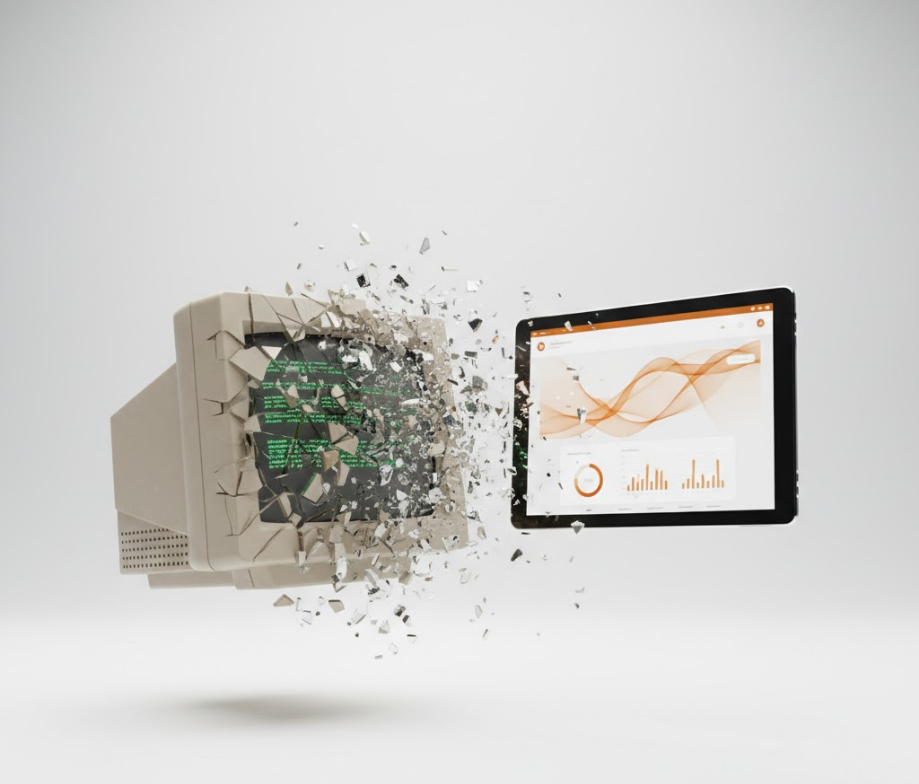
1. Why modernise your software now?
Maintaining "legacy" (inherited) software has hidden costs that many companies ignore until it is too late:
Technical Obsolescence
Difficulty finding developers who know old languages and lack of support on new operating systems.
Lack of Mobility
Your employees need flexibility. Web software enables remote work and access from tablets or mobiles without complex VPNs.
2. The Cloud Migration Process
At ASD Solutions we do not just "move" the software. We apply a re-architecture strategy:
- Business Logic Analysis: We extract the critical rules from your old software so that not a single piece of business knowledge is lost.
- Microservices-based Architecture: We develop with React and Node.js so that your new app is fast, modular and easy to extend.
- Advanced Security: We implement SSL/TLS encryption, two-factor authentication and strict GDPR compliance.
3. Results: Agility and savings
Companies that modernise their applications report an average 30% reduction in maintenance costs and a 50% increase in employee productivity by removing data silos and physical access barriers. By migrating to Cloud architectures with ASD Solutions, your software stops being a fixed, heavy cost and becomes an elastic asset that grows with your revenue. Modernisation is not an expense; it is the most profitable investment to ensure your company's continuity over the next 10 years.
4. Common mistakes when modernising legacy applications
A common mistake is to plan a full rewrite without a prior stabilisation phase. If the current application has critical bugs or inconsistent data, carrying those problems over to the new platform only makes them harder to detect. At ASD Solutions we start by ensuring the minimum health of the existing system and by cleaning the database before opening up the new architecture.
Another frequent problem is trying to replicate the old interface exactly in the new solution, blocking usability improvements that could simplify processes and reduce training time. Modernisation is an opportunity to review flows, remove unnecessary steps and take advantage of current design patterns that your users already know from other modern tools.
Once the system is modernised, it is essential to establish a preventive maintenance plan to ensure the new architecture remains up to date, secure and free of accumulated technical debt.
If your modernisation involves moving infrastructure to the cloud, we recommend reading our guide on on-premise to cloud migration (AWS/Azure) , where we explain the concrete steps, costs and risks of each approach.
What Are Legacy Applications and Why Do They Need Modernising?
A legacy application is any software system that was developed with old technology and, although it still works, presents serious limitations: it does not scale, cannot be integrated with modern tools, generates high maintenance costs and poses a growing security risk. In Spain, thousands of companies still depend on systems developed 10-20 years ago.
Signs that your application needs modernisation:
- The original vendor no longer supports the core technology (e.g. Java 6, PHP 5, .NET Framework 2.0)
- Every small change requires weeks of work and generates unpredictable side effects
- The application does not work correctly on mobile or modern browsers
- The cost of maintaining it exceeds 30% of the annual technology budget
- It cannot connect to external APIs or integrate with modern SaaS tools
Modernisation of Legacy Applications: Strategies and Timelines
There is no single way to modernise. The right strategy depends on the state of the system, available budget and the company's risk tolerance. These are the three most common approaches:
Lift & Shift
Moving the current system to the cloud without changing the code. Fast and economical, but does not solve structural problems. Useful as a first step.
Rearchitecting
Redesigning the architecture (e.g. moving to microservices) without rewriting all the logic. Balance between risk and improvement. Timeline: 1-3 months.
Full Rewrite
New development from scratch, retaining only the business logic. Greater investment but greater long-term ROI. Timeline: 2-6 months.
Modernise your software with our local agency
We help companies across Spain modernise their legacy applications. Find our nearest agency.
Frequently Asked Questions about Application Modernisation
How long does it take to modernise a legacy application?
It depends on the approach chosen. A lift & shift to the cloud can be completed in 1-2 weeks. A microservices rearchitecture usually takes 1-3 months. A full rewrite, 2 to 6 months. We always start with a 1 week diagnosis to determine the best strategy.
What is the risk of modernising a system that still works?
The risk of planned modernisation is always less than doing nothing. An unmodernised legacy system accumulates technical debt that eventually causes downtime or security breaches. We work with incremental phases and parallel environments to guarantee zero business interruption.
Can desktop applications be modernised to web?
Yes, it is one of the most common projects. We transform desktop applications (Visual Basic, Access, Delphi, WinForms) into modern web applications accessible from any device, with the same business logic but a completely new UX.
How much does modernisation of legacy applications cost?
A basic lift & shift project can cost from €800. Microservices rearchitecture of a medium-sized system starts from €1,000-4,000. A complete rewrite of a full ERP or management system can exceed €5,000. The exact budget requires a prior diagnosis of the system.