A logistics company called us because their MySQL 'couldn't cope any more'. Three different developers had touched the database and nobody understood the schema. The problem wasn't MySQL: it was that nobody had designed the data architecture from the start.
Choosing the right database is a strategic decision that affects the performance, costs and scalability of your software. In this guide we explain when to use SQL, when NoSQL and how to avoid mistakes that drag SMEs down for years. If you need professional help, check our database service .
And if your problem is connecting systems that don't talk to each other, our systems integration guide will give you a complementary perspective.

Why Most Companies Choose Badly
70% of SMEs choose their database by inertia or based on what the developer on hand knows, not by technical criteria. These are the three most common mistakes:
- Choosing by hype: adopting MongoDB or Firebase because 'it's what everyone uses' without analysing whether your data is relational (spoiler: it almost always is)
- Not thinking about growth: a database that works with 1,000 records can collapse with 100,000 if it wasn't designed to scale
- Ignoring data integrity: giving up ACID transactions for speed and discovering months later that you have inconsistent data in production
SQL vs NoSQL: Beyond the Debate
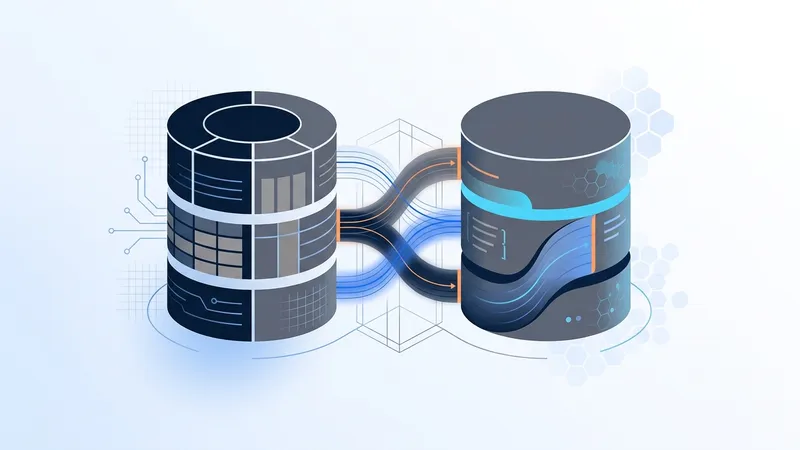
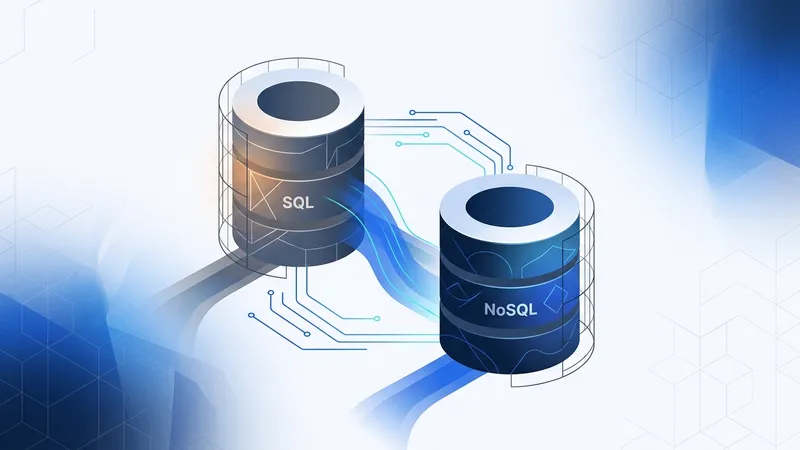
There is no universal answer. The choice depends on the nature of your data, your team and your scalability needs. This table summarises when each option excels:
| Criterion | SQL | NoSQL |
|---|---|---|
| Complex relationships between data | ✓ Ideal | — Limited |
| ACID transactions | ✓ Native | — Partial |
| Complex queries (JOIN, aggregations) | ✓ Powerful | — Basic |
| Massive semi-structured data | — Rigid | ✓ Flexible |
| Frequently changing schemas | — Migrations | ✓ Schemaless |
| Native horizontal scalability | — Complex | ✓ Built for it |
| Team with SQL experience | ✓ Leverageable | — Learning curve |
PostgreSQL: The Safest Choice
If you can only choose one database, choose PostgreSQL. These are the five reasons that make it the safest option for 80% of businesses:
- Full standard SQL support with advanced extensions (JSON, full-text search, GIS) that cover use cases that normally require NoSQL
- Real ACID transactions: your financial data, orders and stock will always be consistent, even with multiple simultaneous writes
- Proven production performance with tables of hundreds of millions of rows, used by companies like Apple, Instagram and Spotify
- Mature and free ecosystem: no licence costs, with enterprise-grade monitoring, backup and replication tools
- Active community and excellent documentation: any problem you encounter already has a documented solution
MongoDB and NoSQL: When It Makes Sense
NoSQL is neither better nor worse than SQL. It simply solves different problems. Here is a clear guide on when to use it and when not to:
When to use NoSQL
- IoT sensor data or massive logs where volume exceeds millions of records per hour and the structure varies
- Product catalogues with highly variable attributes (each product has different fields that change frequently)
- Session cache or temporary data where read/write speed matters more than consistency
- Rapid prototypes where the schema is not yet defined and you need to iterate without constant migrations
When not to use NoSQL
- Financial or accounting data: you need ACID transactions and complete audit trails that NoSQL does not guarantee
- Complex relationships between entities (customers-orders-invoices-products): SQL JOINs are irreplaceable
- Reporting and analytical queries: SQL was designed exactly for this; in NoSQL it is a nightmare
- Small teams without NoSQL experience: the learning curve and design patterns are completely different
Design Mistakes that Drag SMEs Down
We see these mistakes every week in audits. If your company suffers from any of them, the solution is usually simpler than you think:
- No indexes on search columns: queries that take 30 seconds when they should take 30 milliseconds
- Storing everything in a single 'God Table' with 80 columns: impossible to maintain, impossible to scale
- Not using foreign keys or constraints: orphaned data that generates silent errors and incorrect reports
- Unverified backups: 40% of companies discover their backups don't work when they need them
Practical Guide: 5 Steps to Choose
Follow these five steps and you will have an informed decision, not a gamble:
Map your data
Draw the main entities of your business (customers, orders, products, invoices) and their relationships. If there are more than 3 cross-relationships, you need SQL.
Define your critical queries
List the 10 most important queries for your business. If they include JOINs, aggregations or complex filters, SQL is your path.
Estimate your volume at 3 years
Calculate how many records you will have in 3 years. Fewer than 50 million rows per table: PostgreSQL is more than enough. More than 500 million with massive writes: evaluate NoSQL for those specific tables.
Assess your team
If your team is proficient in SQL, don't switch to NoSQL for the sake of trends. A team's productivity with their familiar tool outweighs any theoretical advantage of a new technology.
Test with real data
Before committing, load a subset of your real data into the candidate database and run your critical queries. Generic benchmarks don't reflect your use case.
FAQ: Databases for Businesses
SQL or NoSQL for my SME?
SQL (specifically PostgreSQL) is the right choice for 80% of SMEs. Your customer, order, billing and inventory data is relational by nature. NoSQL only makes sense if you handle massive semi-structured data such as IoT logs or catalogues with highly variable attributes.
PostgreSQL or MySQL?
PostgreSQL is technically superior in almost everything: native JSON support, full-text search, GIS extensions, advanced data types and stricter SQL standard compliance. MySQL is viable if you already have it in production and it works, but for new projects we recommend PostgreSQL without hesitation.
Can I use both at the same time?
Yes, and it is a common practice in modern architectures. PostgreSQL as the main database for relational data and transactions, combined with Redis for cache and sessions, is a proven architecture that offers the best of both worlds without the complexity of MongoDB.
How much does it cost to migrate a database?
Between €600 and €3,000 depending on schema complexity, data volume and existing integrations. The key is a gradual migration plan: first duplicate data in the new database, then migrate reads and finally writes. Never do a 'big bang' overnight.
Conclusion
The database is the foundation of all your software. A bad choice drags on for years in the form of poor performance, inconsistent data and rising maintenance costs. For 80% of businesses, PostgreSQL is the safest option: it combines SQL power with JSON flexibility, scales to hundreds of millions of records and has no licence costs. If your case requires NoSQL, use it for what it truly excels at (massive semi-structured data) and keep SQL for the core of your business. What matters is not following trends, but choosing with data and a solid design from day one.