Your business needs an app. The vendor offers two paths: a PWA at half the price or a native app with more features. How do you decide without knowing exactly what each one is?
In this guide we analyse in depth what a PWA is, when it makes sense over a native app and how a good web development team can help you make the right decision for your business.
The Dilemma: PWA vs Native App
Eight out of ten SMEs that come to our consultancy with the idea of building a mobile app don't need a native app. But nobody has explained it to them before, and that costs them thousands of euros more than necessary.
- They pay €2,000-7,000 for a native app when a €1,500 PWA would cover 95% of their needs.
- They double costs by maintaining separate iOS and Android versions without the user volume to justify it.
- They suffer weeks-long app store review times when they need to iterate quickly.
- They discover too late that their users prefer accessing from the browser and never download the app.
The key is not which technology is better in the abstract, but which one solves your specific problem at the lowest cost.
What Is a PWA
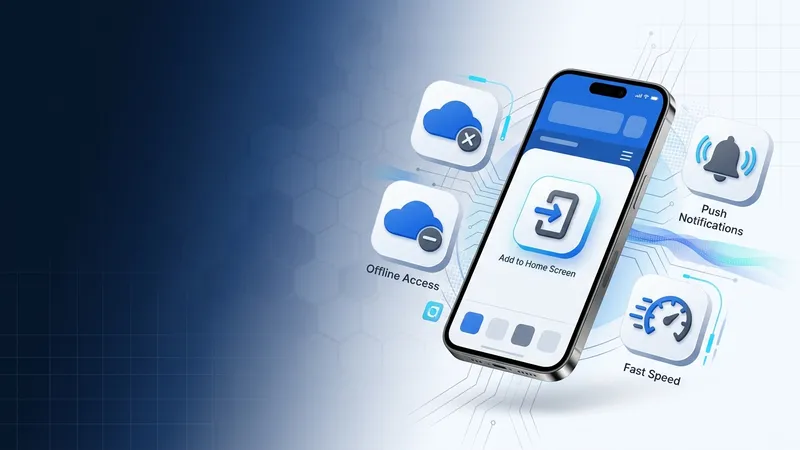
A Progressive Web App is a web application that uses modern browser technologies (service workers, manifest, HTTPS) to deliver an experience similar to a native app: installable, fast and with offline capability.
A responsive website adapts visually to different screens, but it remains a conventional web page: it needs a permanent connection, cannot be installed and does not send push notifications.
A PWA goes a step further: it works offline thanks to service workers, installs on the home screen like an app, sends push notifications and updates automatically without user intervention or app store approval.
A native app is compiled specifically for iOS or Android, has full access to device hardware (NFC, advanced Bluetooth, biometric sensors) and is distributed exclusively through app stores.
PWA vs Native vs Web: Comparison
Detailed comparison by criterion
| Criterion | Traditional Web | PWA | Native App |
|---|---|---|---|
| Development cost | €600-3,000 | €1,500-6,000 | €2,000-7,000 |
| Time to launch | 2-4 weeks | 3-5 weeks | 6-10 weeks |
| Offline functionality | No | Yes (service workers) | Yes (native) |
| Push notifications | No | Yes (Web Push API) | Yes (APNs / FCM) |
| Installable on device | No | Yes (A2HS) | Yes (app stores) |
| Advanced hardware access | None | Limited | Full |
| Updates | Instant | Instant | Requires approval |
| SEO & indexing | Excellent | Excellent | None |
| App store commission | 0% | 0% | 15-30% |
| Annual maintenance cost | €100-500 | €200-800 | €300-1,500 |
When PWA Is the Right Choice
A PWA fits perfectly when the goal is to maximise reach and minimise cost without sacrificing user experience.
- Internal tools (work orders, time tracking, stock queries) where employees use varied devices.
- Product catalogues and client portals that need to work offline in areas with poor coverage.
- E-commerce where SEO and loading speed are critical for conversion.
- Event or trade show applications where users don't want to download an app for one-time use.
- MVPs and idea validation where you need to launch fast, iterate and pivot without app store costs.
When You Need Native
- Games or apps with intensive 3D graphics that demand maximum GPU performance.
- Apps that depend on Bluetooth LE, NFC or advanced biometric sensors.
- Augmented reality applications that need full access to the camera and motion sensors.
- Products where presence in the App Store or Google Play is a business or trust requirement.
- Apps with heavy background processing that need to run long tasks without browser restrictions.
Real-World Use Cases
Logistics company
They needed drivers to log deliveries without coverage. A native app cost €5,000 and required maintaining iOS + Android.
PWA with offline sync: €1,500-6,000, launched in 8 weeks. 100% team adoption without installing anything.
Restaurant chain
Digital menu with ordering. The native app had only 800 downloads after 6 months and cost €800-3,000.
QR-accessible PWA: €1,500-6,000, +340% digital orders in 3 months. SEO indexed each restaurant.
Training consultancy
Course portal for their clients' employees. Each client had different app installation policies on corporate devices.
PWA with no MDM restrictions: €1,500-6,000, deployed across 12 companies without IT department intervention.
Limitations You Should Know
- On iOS, PWAs cannot access Bluetooth, NFC or run prolonged background tasks. Apple improves support every year, but it still lags behind Android.
- Local storage is limited to around 50 MB per origin in most browsers, insufficient for apps with large offline data volumes.
- Push notifications on iOS require the user to add the PWA to their home screen; they don't work directly from Safari browser.
- You have no presence in app stores (although you can package the PWA with TWA for Google Play if needed).
FAQs: PWA for Businesses
How much does it cost to develop a PWA?
A professional PWA for business costs between €1,500 and €6,000, 40-60% less than an equivalent native app. The savings increase in maintenance: €200-800/year compared to €300-1,500 for a native app.
Does a PWA work without an internet connection?
Yes. Thanks to service workers, a PWA can cache resources and data to work offline. When it regains connection, it automatically synchronises changes with the server.
Can a PWA be installed like a regular app?
Yes. On Android the experience is practically identical to a native app: it installs from the browser, appears in the app drawer and runs full-screen. On iOS it can also be added to the home screen with minor limitations in notifications and storage.
PWA or native app for my business?
For internal tools, catalogues, client portals and MVPs, the PWA is the most cost-effective option. You only need a native app if your product requires advanced hardware (Bluetooth, NFC, AR) or app store presence is a business requirement.
Conclusion
PWAs have moved beyond experimental technology to become the default choice for most enterprise applications. They deliver 90% of the native experience at a fraction of the cost, with instant updates and without the friction of app stores.
Before investing in a native app, consider whether you truly need advanced hardware access. If the answer is no, a PWA will save you time and money. To explore the differences between mobile approaches further, check our mobile app development guide .