A company is only as efficient as the communication between its tools. Custom ERP and CRM integration is the bridge that eliminates manual work and data errors.
Many companies operate with "information islands": one software for sales, another for warehouse and another for billing. At our software development agency , we specialise in connecting custom software through robust APIs, ensuring your data flows without friction.
Every manual Excel export, every CSV file sent by email and every copy/paste between different systems is a potential leak of money. When an integration is well designed, data moves by itself between tools, is validated automatically and always reaches the right destination. The goal of our integration projects is for your team to stop acting as "human glue" between applications and focus on higher-value tasks.
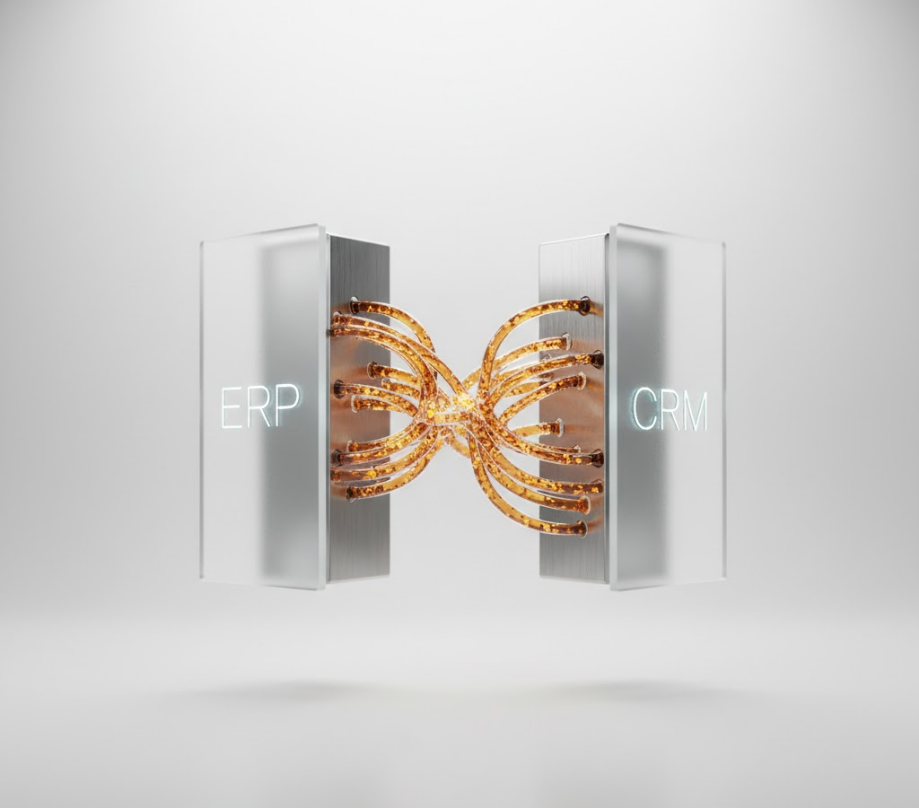
Benefits of API automation
- Real-Time Synchronisation: Stock, orders and customers always up to date across all channels.
- Elimination of Manual Tasks: Save hundreds of hours per month by avoiding data duplication.
Success Stories in Technical Integration
We have implemented complex integrations ranging from connecting PrestaShop stores with industrial ERPs such as SAP or Sage, to logistics systems that feed CRMs like Salesforce in real time. The key to a successful integration is not just moving data from one place to another, but error handling and data integrity. Our IT consulting focuses on building digital bridges that work reliably, enabling managers to make decisions based on real, consolidated data.
Common mistakes when integrating ERP, CRM and eCommerce
Before designing an integration architecture, we analyse what previous attempts have been made and what pain they have caused. It is common to find integrations based on isolated scripts, poorly configured generic connectors or quick developments that do not consider real data volumes. Here are some mistakes we often see:
- Lack of a master data system: each tool "believes" it has the truth about customers or stock, causing constant conflicts.
- Unidirectional integrations: changes are synced in one direction but not the other, breaking information consistency.
- No monitoring: sync failures are only detected when someone complains or a serious error occurs.
- Excessive coupling: a small change in one system breaks the entire chain because intermediate layers or clear contracts were not designed.
Best practices for a sustainable integration
To prevent the integration from becoming a new source of problems, we work with clear principles: define a common data model, use documented APIs, add message queues when volume requires it and set up proactive alerts. We also always recommend a testing phase with real data and edge scenarios before going to production.
We also help internal teams understand the new information flow: which tool is the source of each piece of data, how conflicts are resolved and what to do when an integration temporarily fails. This organisational part is as important as the technical one for the project to succeed in the long term and not depend solely on the memory of a single vendor.
IT Consulting in Valencia and Madrid
We help companies across Spain modernise their technology stack. If your eCommerce does not talk to your warehouse, you are losing money every minute.
If your company is in Madrid and you are looking for a complete integration project, discover our custom software development services in Madrid with success stories specific to the Madrid business community.
What is ERP Integration with an API?
ERP integration via API is the programmatic connection between your enterprise resource planning system (ERP) and other tools (CRM, eCommerce, logistics) via application programming interfaces. Unlike manual exports, data flows in real time and bidirectionally, without human intervention.
| Integration type | How it works | When to use | Scalability |
|---|---|---|---|
| Nativa | Official connector between two products from the same manufacturer | When both systems are from the same vendor (e.g. SAP + SAP CRM) | Limited to the manufacturer's ecosystem |
| API REST | HTTP calls between systems with clear contracts (documented endpoints) | When systems have well-documented REST APIs | High — can be extended to any service |
| Middleware | Central platform (iPaaS, Kafka, RabbitMQ) that orchestrates the data flow | When there are many systems to connect or volume is high | Very high — ready for complex architectures |
Email Integration in ERP and CRM
Email integration in an ERP or CRM means that every email sent or received is automatically logged in the customer history, without anyone needing to copy it manually. This radically improves the traceability of commercial communications and reduces internal misunderstandings.
Custom CRM Integrations: When and How
A custom CRM integration makes sense when the native integrations of your CRM (Salesforce, HubSpot, Pipedrive) do not cover your specific use case: very particular processes in your sector, your own legacy systems, or data requirements that standard templates do not address. At ASD Solutions we design the exact connector you need, with the correct business logic.
If your company is based in Valencia and you are looking for a team specialising in integration and software development, we recommend reading our article on consultancy in Valencia , where we explain how we work with local businesses.
Systems integration in your city
We connect ERPs, CRMs and legacy systems for companies across Spain. Find our nearest agency.
Frequently Asked Questions about ERP and CRM Integration
What does it mean to integrate an ERP with an API?
Integrating an ERP with an API means connecting your enterprise management system with other tools (CRM, eCommerce, logistics) via programming interfaces. Data flows automatically between systems without manual exports or duplication errors.
How much does it cost to integrate an ERP with a CRM?
The cost depends on the complexity of the systems and data volume. A basic integration between a standard ERP (Sage, Holded) and a CRM like HubSpot can cost between €1,000 and €3,000. Integrations with legacy systems or highly specific business logic can exceed €2,000.
Can email be integrated with an ERP?
Yes. Email integration with an ERP or CRM means that every email is automatically logged in the corresponding customer or order history. This eliminates the need for someone to manually copy the information and improves traceability.
What is an ERP with robust APIs?
An ERP with robust APIs is one that exposes its functionalities via well-documented REST endpoints, with secure authentication, clear error handling and API versioning. This allows it to be integrated with any external tool without depending on proprietary connectors or manual exports.