44.5% of Spanish companies still combine manual and automated processes. It is not a tools problem — it is a methodology problem.
DevOps is not about installing Jenkins or buying GitLab licences. It is about reducing the time between a developer writing a line of code and a user enjoying it. In this guide we break down how to implement DevOps in the real context of a Spanish company, without Silicon Valley budgets or 50-engineer teams. Our Cloud and DevOps services are designed for exactly that scenario.
The Real Cost of Not Implementing DevOps
Before talking about tools, let us talk about the cost of doing nothing. Every month without automation accumulates operational debt:
- Manual deployments consuming 8-12 hours of engineering time per week
- Configuration errors between environments causing avoidable incidents
- Failure recovery time measured in hours, not minutes
- Developers demotivated by repetitive tasks instead of creating value
- Customers suffering unnecessary maintenance windows
DevOps in SMEs vs Large Companies
DevOps is not the same in an 8-person startup as in a corporation with 200 developers. The differences are key to deciding the strategy:
| Aspect | SME (5-30 people) | Large Company (100+) |
|---|---|---|
| Team | 1-2 people do dev + ops | Dedicated platform teams |
| Budget | Free tools + basic cloud | Enterprise licences + multi-cloud |
| Speed of change | Fast, less bureaucracy | Slow, many stakeholders |
| Technical debt | Accumulates fast without processes | Managed by dedicated teams |
| Experience | Learning on the go | Hired specialists |
CI/CD: Automation Without Complexity
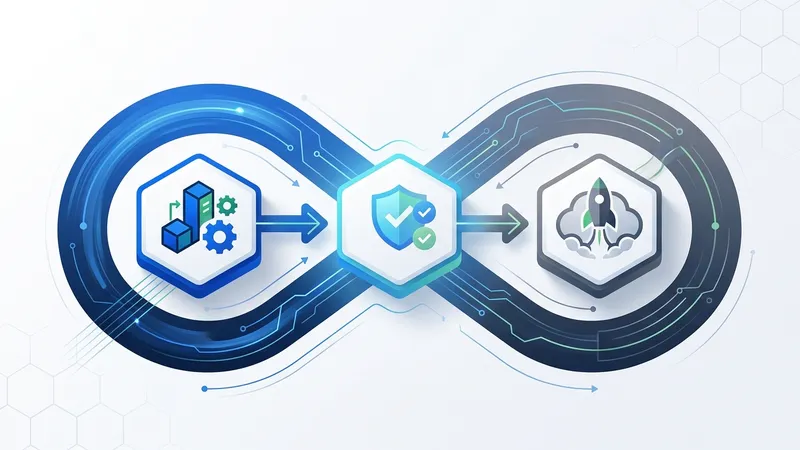
A well-designed CI/CD pipeline eliminates 90% of manual deployment work. These are the essential stages:
Commit and Push
The developer pushes code to the branch. The pipeline starts automatically.
Build and Lint
The project is compiled and style and code quality rules are verified.
Automated Tests
Unit tests, integration tests and security tests run in parallel.
Deploy to Staging
If tests pass, it deploys automatically to a testing environment.
Deploy to Production
After manual or automatic validation in staging, it deploys to production with automatic rollback.
Recommended CI/CD Stack in Spain
- GitHub Actions or GitLab CI: free for small teams, no self-hosted server needed
- Docker to package applications with exact dependencies
- SonarQube Community for code quality analysis
- Terraform or Pulumi to define infrastructure as code
Docker and Kubernetes: When Yes, When No
Docker is almost always a good idea. Kubernetes is not always. The decision depends on the real context of your company:
Docker/Kubernetes YES when...
- You have 5+ microservices that scale independently
- Your traffic has predictable spikes (Black Friday, campaigns)
- You need mandatory zero-downtime deployments
- Your team has at least one person with container experience
Kubernetes NO when...
- You have a monolith with 1-2 services that scale together
- Your traffic is stable and predictable throughout the year
- You have nobody who understands K8s complexity
- Your budget does not cover the overhead of a managed cluster
4 Pillars of DevOps Culture
Tools without culture are just expenses. These four pillars transform the way a team works:
Shared ownership
The developer who writes the code is responsible for its deployment and monitoring. No more 'that is the ops team's problem'.
Short feedback loops
Every push generates feedback in under 10 minutes: tests, linting, build. If something fails, you know immediately.
Blameless postmortems
When something fails in production, the system is analysed, not the person. It is documented and prevention is automated.
Measurable continuous improvement
4 key metrics are tracked: deployment frequency, lead time, failure rate and recovery time. Each sprint improves one.
Real Cases in Spain
Three DevOps implementations we have carried out with Spanish companies in the last 12 months:
Fintech Barcelona: From 2 releases/month to 12 releases/week
Sector: Fintech | Team: 14 developers
They migrated from manual SSH deployments to CI/CD pipelines with GitHub Actions and Docker. In 6 weeks they went from 2 monthly releases to 12 weekly, with 70% fewer production incidents.
eCommerce Madrid: Zero-downtime on Black Friday
Sector: Retail | Team: 8 developers
We implemented auto-scaling with ECS Fargate and canary deployments. Their first Black Friday without downtime, handling 15x normal traffic without manual intervention.
SaaS Valencia: From 4-hour deploy to 8 minutes
Sector: SaaS B2B | Team: 5 developers
We automated the entire pipeline: tests, build, deploy and rollback. Deployment time went from 4 hours (with manual checks) to 8 minutes fully automated.
90-Day Plan
You do not need to transform everything at once. This 3-month plan is realistic for a Spanish SME:
Month 1: Foundations
Basic Pipeline
- Set up Git repository with protected branches
- Create CI pipeline with automatic build and tests
- Dockerise the main application
Month 2: Automation
Automatic Deploy
- Configure automatic deploy to staging
- Add code quality analysis
- Implement basic monitoring alerts
Month 3: Culture
Team Processes
- Establish mandatory code review process
- Implement blameless postmortems
- Measure and publish the 4 DORA metrics
FAQ: DevOps for Spanish Companies
How long until you see results with DevOps?
The first tangible benefits appear in 2-4 weeks: fewer deployment errors, faster feedback and less manual work. Full cultural transformation requires 1-3 months of consistent effort.
Do I need to hire a DevOps specialist?
Not to start. The most effective approach is to identify a curious person on the team who dedicates 30-40% of their time to automation. An external consultant can accelerate the first weeks, but the knowledge should stay in-house.
Docker or Kubernetes for my company?
Docker always. It is the foundation of containerisation and benefits any project. Kubernetes is only worth it if you have 5+ independent microservices and significant traffic spikes. For the rest, Docker Compose or ECS Fargate are sufficient.
How much does it cost to implement DevOps?
The base tools are open source and free (GitHub Actions, Docker, SonarQube Community). Managed alternatives like GitLab Premium or Datadog cost 200-500 EUR/month. The ROI is recovered in 2-4 months from engineering hours saved alone.
Conclusion
DevOps is not a destination — it is a way of working. Spanish companies that invest in automation, team culture and continuous improvement do not just deploy faster; they attract better talent and reduce operational costs. You do not need a multinational's budget to start. You need a realistic plan, tools suited to your context and the willingness to measure and improve every week.