You've been paying for a SaaS for three years that worked fine with 15 employees. Now you have 45, and the system can't connect to your logistics platform. Your team exports data to Excel every day to fill in what the software can't do.
This frustration marks the point where many Spanish companies seriously evaluate the question: custom ERP vs SaaS? It's not a theoretical debate. It's a decision with real impact on costs, operations and growth. In this article we compare both options with concrete data and decision criteria that complement our ERP-CRM integration guide . No vendor bias.
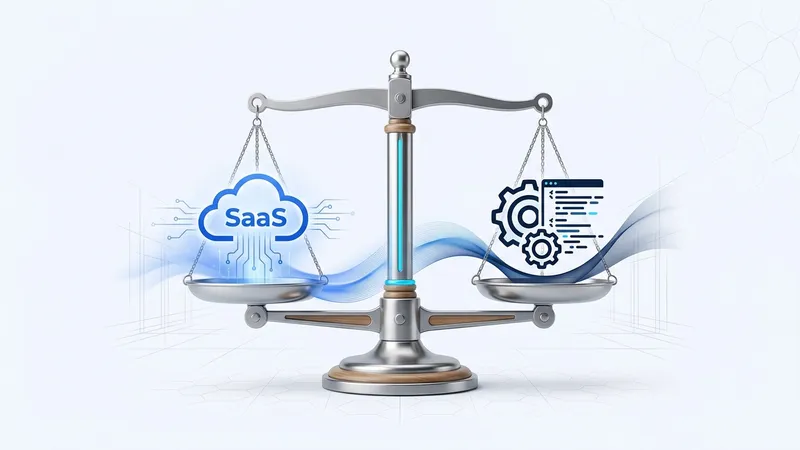
Why so many ERP implementations miss their goals
According to various industry studies, the majority of ERP initiatives fail to meet their initial objectives. For Spanish SMEs with 10 to 150 employees, the impact is greater because the margins for error are smaller. There comes a moment when the business outgrows the software:
- The processes that differentiate you from competitors don't fit into predefined modules
- Adding an integration requires months in the hands of the vendor's support team
- Every new feature means additional licence costs or a flat refusal
- The team creates parallel processes in Excel to cover the system's shortcomings
The problem isn't SaaS itself. It's choosing a generic SaaS for processes that aren't generic.
Custom ERP vs SaaS: Clear Definitions
A standardised platform in the vendor's cloud. Customisation exists, but within boundaries the vendor has defined. Odoo allows more customisation (open source); Holded or Sage are more closed.
- Quick start: 2-4 weeks operational
- Low and predictable initial cost
- Customisation limited to configuration
- Vendor lock-in: high provider dependency
A system built specifically for your company's processes. No templates or prefabricated modules: it models exactly how your business actually works. Uses modern technologies (React, Node.js, PostgreSQL) and agile methodologies.
- 100% adapted to your real processes
- Full ownership of code and data
- API integrations designed to measure
- No provider dependency (zero vendor lock-in)
Direct comparison: Generic SaaS vs Custom ERP
| Aspect | Generic SaaS | Custom ERP |
|---|---|---|
| Code ownership | Vendor's | Yours |
| Data ownership | Shared | 100% yours |
| Customisation | Limited to configuration | No functional limits |
| Startup time | 2-4 weeks | 1-3 months |
| Initial cost | Low | Medium-high |
| 5-year TCO | €50-70k | €60-75k |
| Vendor dependency | High (vendor lock-in) | None |
| API integrations | Paid, limited | Designed ad-hoc |
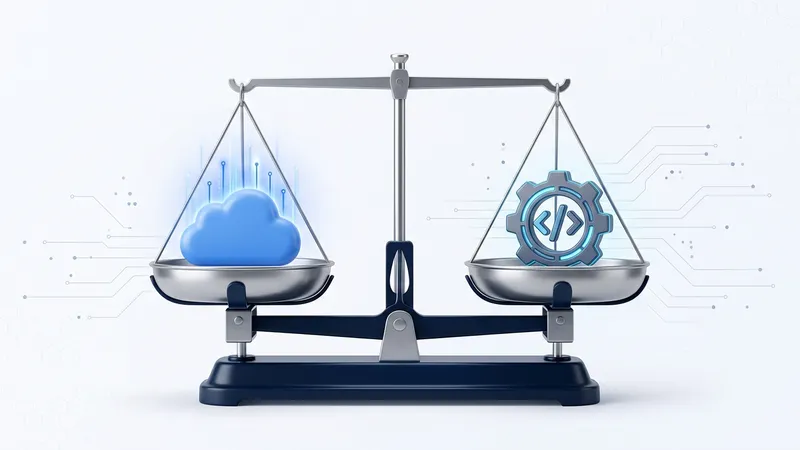
TCO Analysis: Real Cost at 3 and 5 Years
The most common trap: comparing SaaS initial cost (low) with development initial cost (high) and concluding that SaaS is cheaper. The correct analysis uses TCO (Total Cost of Ownership): how much each option costs when you add everything up.
SaaS TCO Projection (SME 30-50 employees)
| Item | Year 1 | Year 3 | Year 5 |
|---|---|---|---|
| Subscription | €2,400 | €7,200 | €12,000 |
| Implementation | €650 | — | — |
| Extra modules | €2,400 | €7,200 | €12,000 |
| Adaptation consulting | €350 | €750 | €1,250 |
| Cumulative total | €5,800 | €15,800 | €25,900 |
Custom ERP TCO Projection (SME 30-50 employees)
| Item | Year 1 | Year 3 | Year 5 |
|---|---|---|---|
| Initial development | €3,500 | — | — |
| Maintenance/evolution | €450 | €1,350 | €2,250 |
| Cloud infrastructure | €1,200 | €3,600 | €6,000 |
| Cumulative total | €5,150 | €8,450 | €11,750 |
At 5 years, custom ERP ends up cheaper than SaaS, and also includes a 100% proprietary system, no variable licence costs, no vendor dependency and features designed for you.
Get an indicative estimate for your project in 24h
Tell us what you need and we send you a written price and timeline range. No sales calls: the engineer who would build your project replies.
Request a free estimateFunctional Scalability: Where Generic SaaS Falls Short
SaaS scales in users, but ignores functional scalability: the system's ability to evolve when your business processes evolve. Generic SaaS falls short because:
- Deep customisation breaks their model: their advantage is standardisation
- Integrations depend on the vendor: if you want to connect a custom CRM or specific BI system, you wait for the vendor to build that connector
- Vendor lock-in is tangible: a large share of organisations prioritising digital transformation end up facing challenges from vendor dependency
A custom ERP with modern scalable architecture allows connecting with any system and evolving module by module. See our backend and API development services for limitless integration.
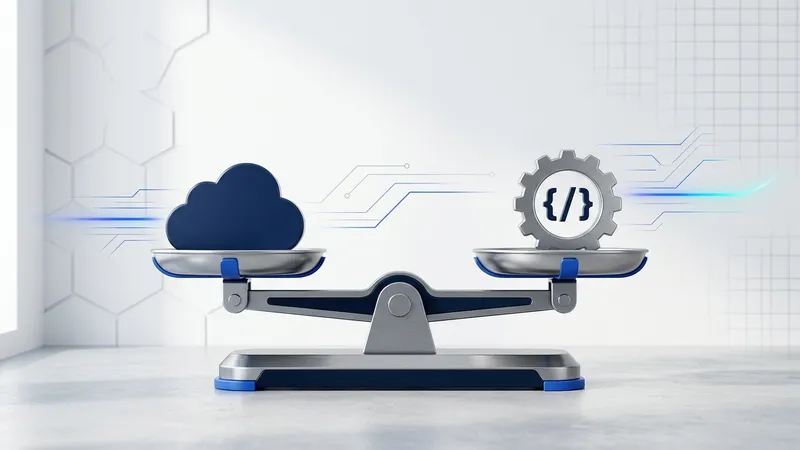
Implementation Time
Standard SaaS
1-4 weeks
Custom ERP
1-3 months
SaaS has the advantage in speed, but the correct comparison isn't how long it takes to start, but how long it takes to generate net value. A quick SaaS implementation that then requires months of manual adaptations and corrective consulting can cost more in operational disruption than an agile development with functional deliveries every 2-3 weeks.
Risks and Disadvantages of Each Option
SaaS Risks
- Vendor lock-in: switching providers after 3 years is expensive and risky
- Functional limitations: there will be things you simply cannot do
- Hidden costs: extra modules, integrations, additional users
- Low differentiation: your competitor uses the same software
Custom ERP Risks
- Requires internal technical team or continuous external support
- Technical debt: poor early code costs dearly later
- Initial vendor dependency: switching providers can also be complex
- Longer initial timeline: go-live takes longer than SaaS
Decision Criteria: When to Choose Each?
Choose SaaS if:
- Your processes are standard in your sector (no technological differentiators)
- Your team is very small (<20 people) and you have no internal IT
- You need to move fast (<4 weeks) due to an urgent operational problem
- Your budget is very limited (<€2,500)
- You don't plan to grow significantly in the next 3-5 years
Choose Custom ERP if:
- Your processes are complex or differentiating (unique operational rhythm)
- You need deep integrations with other systems
- You plan to grow and don't want to change software in 3 years
- You value control and data ownership
- Your budget allows €2.5-5.5k (typical for Spanish SMEs)
- You have or can build a technical team to maintain the system
How to decide between custom ERP and SaaS
The decision is not ideological, it is about fit. If your operation is standard and the SaaS processes resemble yours, buying is faster and cheaper. But if your competitive advantage lives in a process no SaaS covers well, adapting to its way of working holds you back exactly where you should stand out. The real cost of SaaS is not the monthly fee: it is the customisations that pile up, the integrations you pay for separately, and the day the price goes up and you cannot leave because your data lives inside their product.
The honest way to decide is to measure the three-year total cost and map which processes are differentiating and which are generic. If you want that analysis done by engineers and not by a salesperson, a 190 € technical audit with a 72-hour diagnosis gives you the comparison applied to your specific case, with fixed cost and timeline; the 190 € is credited if we then build the project.
Checklist before signing an ERP
Before committing to any ERP, custom or SaaS, check five things: that you can export all your data in an open format whenever you want; that the integrations with your other systems are documented and do not depend on a single person; that the total price (licences, modules, support and customisations) is fixed in writing; that you know who maintains the system and with what response times; and that the contract does not lock you in with disproportionate exit penalties. If any answer is vague, that is exactly the crack that will cost you money later.
FAQ: Custom ERP vs SaaS
How much does a custom ERP cost vs a SaaS in Spain?
A SaaS starts at €49-200/month plus implementation (€500-800). A custom ERP for SMEs costs €2,500-5,500 in initial development plus €450/year in maintenance. At 5 years, custom ERP typically ends up cheaper than SaaS, with the added benefit of full code ownership.
How long does it take to implement a custom ERP?
Between 1 and 3 months from analysis to go-live. With agile methodologies (Scrum), you receive functional deliveries every 1-2 weeks, so you can validate and adjust in real time without waiting until the end of the project.
Is SAP Business One, Odoo or custom development better?
It depends on your complexity. SAP Business One and Odoo are excellent for standard processes. If your processes are differentiating or you need deep integrations that these platforms don't offer, custom development is more efficient in the medium term.
What happens to my data if I leave the SaaS?
It depends on the provider. Some allow full data export in CSV or JSON; others limit exports. With a custom ERP, data is 100% yours: you can migrate, back up and manage without third-party restrictions.
Can I migrate from a SaaS to a custom ERP without stopping the business?
Yes. It is done in phases: first the critical core, keeping the SaaS running in parallel, and the rest is migrated once the new system is proven. The key is to export your data and document the integrations from the start.
When is a custom ERP NOT worth it?
When your processes are standard and a mature SaaS covers them without forcing you to work backwards. If you have no differentiating process to protect, pay the subscription and spend the budget on what actually sets you apart.
Conclusion: The Decision Isn't Binary
The custom ERP vs SaaS question has no universal answer. It depends on your company, your processes, your budget and your growth stage. But three points hold true for every Spanish SME: the total cost at 5 years is similar, a generic SaaS in a complex business is more expensive than it seems because workarounds cost hours of work every day, and a well-built custom ERP is an investment, not an expense. The key is to map your core processes, be honest about their current limitations and choose a technology partner who understands your sector, speaks your language and takes responsibility for results.
